
Gluten-Free Carbonara in Rome

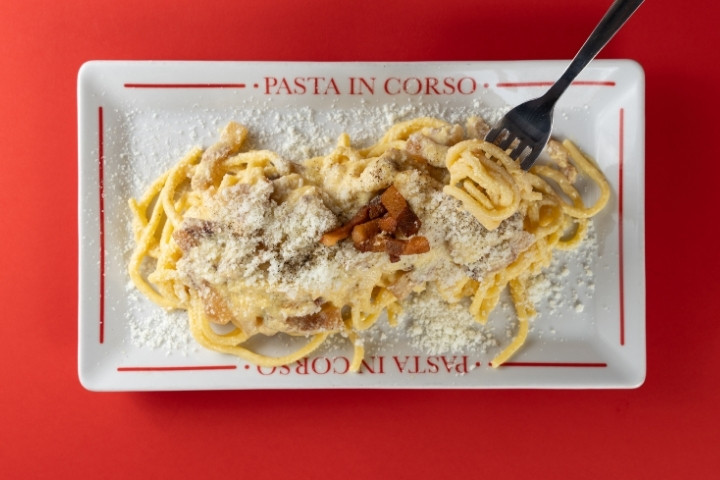
Gluten-free carbonara in Rome at Pasta in Corso: a fully gluten-free restaurant with a separate kitchen, where everyone can enjoy the same traditional Roman dishes without differences. Carbonara, a symbol of Rome, has been a complex technical challenge to recreate without gluten.
PAGE SUMMARY
- Gluten-Free Carbonara in Rome
- Where to Eat Gluten-Free Carbonara in Rome
- The Challenges of Making a Great Gluten-Free Carbonara
- How We Prevent Cross-Contamination
- Why Many Consider It the Best Gluten-Free Carbonara in Rome
- Ingredients of Our Gluten-Free Carbonara
- How We Prepare Our Gluten-Free Carbonara
Gluten-Free Carbonara in Rome
If you are looking for a gluten-free carbonara in Rome, you can find and enjoy it at Pasta in Corso, a completely gluten-free restaurant with a dedicated kitchen for people with celiac disease. Pasta in Corso was founded on a simple idea: to be the first gluten-free restaurant, but also not, because here gluten-free dining does not create differences at the table and everyone can enjoy the same traditional Roman dishes together. Carbonara is one of Rome’s most iconic dishes, and recreating it without gluten proved to be a much more complex technical challenge than one might imagine.
In our restaurant, we prepare carbonara using gluten-free pasta (entirely produced by us) made with special flours that allow us to achieve the same creaminess, texture, and ability to emulsify as traditional carbonara. The result is a dish designed for people with celiac disease but appreciated even by those who normally eat gluten-containing pasta. It is so good that, in blind tastings, 90% of people who try both versions of carbonara are unable to identify the gluten-free one. You can enjoy our gluten-free carbonara at any of our four locations in central Rome.
Where to Eat Gluten-Free Carbonara in Rome
Our gluten-free carbonara can be enjoyed both in the restaurant and as takeaway at all four of our restaurants in Rome.
- Pantheon – Via della Maddalena 43, in the city centre
- Cavour-Prati – Piazza Cavour 17/b, in the Prati district.
- Corso Vittorio Emanuele II 273, just a few minutes from Trastevere.
- Monti-Colosseum – Via dei Serpenti 9, less than 5 minutes on foot from the Colosseum and the Imperial Forums.
All our locations are easily accessible by public transport or car and are situated near some of Rome’s most beautiful and popular areas. This allows visitors to enjoy a gluten-free lunch or dinner without leaving the historic centre. It is also an opportunity for Romans to sit down and enjoy an outstanding carbonara without worrying about food intolerances or celiac disease.
The restaurant is entirely gluten-free, and the kitchen is dedicated exclusively to preparing gluten-free dishes. This allows people with celiac disease to dine with complete peace of mind without concerns about contamination. Many customers choose our restaurant specifically because they are looking for a safe place to enjoy traditional Roman dishes such as carbonara, amatriciana, and cacio e pepe in a gluten-free version.
The Challenges of Making a Great Gluten-Free Carbonara
Carbonara is one of the most iconic dishes of Roman culinary tradition. The traditional recipe is simple and based on just a few ingredients, which today are widely known thanks to social media.
- Pasta
- Guanciale (yes, we know you know. No pancetta)
- Eggs
- Pecorino Romano (same as above. Yes, we know you know Parmesan does not belong in it)
- Black pepper
Our intention here is not to debate the origins of the recipe, especially since the “fundamentalism” surrounding guanciale, carbonara cream, and pecorino appears to be a fairly recent phenomenon. Instead, we want to focus on the technical challenges we faced in creating a carbonara worthy of its name, but without gluten.
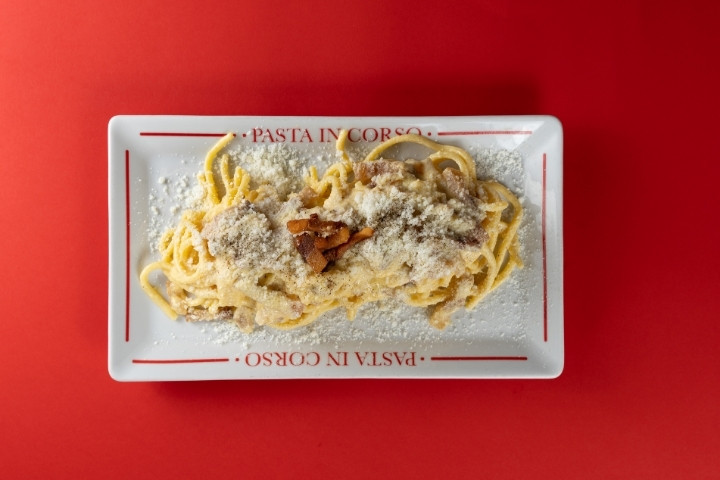
Precisely because the ingredients are so simple, any variation in the pasta’s texture or in the final emulsification can completely change the result of the dish. When it comes to gluten-free carbonara, the key challenge is not simply replacing an ingredient, but recreating the same behaviour as traditional pasta during cooking and emulsification. Gluten is responsible for the pasta’s elastic structure and its ability to maintain consistency during cooking. In gluten-free pasta, this structure must be recreated through the balance of different flours and the proper handling of the dough. If the pasta is not developed correctly, it tends to break apart or fails to release the starch needed for emulsification. Carbonara requires a perfectly emulsified sauce made from eggs, pecorino cheese, and pasta cooking water. If the pasta does not release the right amount of starch, the sauce will not bind properly and the dish loses its characteristic creamy texture.
For this reason, in our restaurant we use a gluten-free flour blend developed in-house (tapioca, rice, and corn), specifically designed to produce pasta with a structure, cooking performance, and starch release very similar to traditional pasta.
The result we achieved after (many, many) tests is a perfectly creamy, well-bound carbonara, with a sauce that does not split and a texture identical to that of traditional pasta. Every week we invite many of our customers (who are neither celiac nor gluten-intolerant) to try both versions blindfolded. Nine out of ten cannot tell which one is gluten-free.
How We Prevent Cross-Contamination
Cross-contamination can be extremely dangerous for people with celiac disease. It is usually linked to:
- Using the same utensils for gluten-free and non-gluten-free dishes, or utensils that have not been properly sanitised
- Producing bread, flour, pasta, and other bases in the same laboratory
- Shared kitchens
- Shared pasta cookers or frying oil
- Unreliable identification systems for gluten-free dishes
To minimise risks, at Pasta in Corso we produce our pasta in separate laboratories. All utensils and machinery dedicated to gluten-free production are either separate or thoroughly sanitised, and the same applies to pasta cookers and serving plates. In most gluten-free restaurants, carbonara and other gluten-free dishes are identified with a small flag. However, flags can fall off or be moved.
All Pasta in Corso restaurants instead use a safer system based on the shape of the plates. In addition to having separate kitchens, every dish leaving the kitchen is visually different. Gluten-free dishes are always served on rectangular plates, while gluten-containing dishes are served on oval plates. This system completely eliminates the risks associated with labels or flags.
Why Many Consider It the Best Gluten-Free Carbonara in Rome
A gluten-free carbonara can only be considered truly successful when it is indistinguishable from the traditional version. As mentioned earlier, we achieved this thanks to a blend of naturally gluten-free flours. Our pasta is entirely made by us, in every shape and format. The pasta we use for carbonara (long pasta) releases the starch needed for emulsification, and the egg-and-pecorino cream binds perfectly with the guanciale and the pasta cooking water. Below are the results.
In the blind taste test video, several people try two carbonaras without knowing which one has been prepared with gluten-free pasta. The result is surprising: nobody is able to confidently identify which carbonara is gluten-free.
This demonstrates just how close the texture and creaminess can be to the traditional version when the pasta is properly developed and the preparation follows authentic Roman culinary techniques. In addition to the satisfaction of our customers, we are regularly mentioned by major food and celiac-focused publications as a benchmark in Rome for traditional Roman dishes (including amatriciana, cacio e pepe, and gricia) made 100% gluten-free.
Ingredients of Our Gluten-Free Carbonara
Our gluten-free carbonara follows the traditional Roman recipe, using simple, high-quality ingredients. The main ingredients are:
- gluten-free pasta made with special flour blends
- guanciale
- Pecorino Romano PDO
- fresh eggs
- freshly ground black pepper
The guanciale is carefully selected to achieve the right balance between fat and lean meat. During cooking, it releases the fat that contributes to the creaminess of the sauce. We use high-quality guanciale from Lazio, following tradition. Pecorino Romano PDO is essential to the structure of the sauce. Its distinctive flavour and ability to bind with the eggs form the foundation of authentic carbonara.
We choose pecorino cheeses that are savoury but not overpowering. The ideal balance for a carbonara that is rich in flavour while remaining harmonious and not excessively salty. Fresh eggs make it possible to achieve the characteristic carbonara emulsion. The secret of the recipe is not cooking the eggs, but creating a velvety sauce through emulsification with the pasta cooking water. But on that subject, we know you are already experts
How We Prepare Gluten-Free Carbonara in Our Restaurant
The preparation of our gluten-free carbonara follows the traditional techniques of Roman cuisine. The pasta is cooked until it reaches the perfect al dente texture. Meanwhile, the guanciale is slowly browned to achieve crispness and release the fat needed for the final emulsification. The eggs and pecorino cheese are combined until they form a smooth, homogeneous cream. The pasta is then transferred to the pan with the guanciale and emulsified with the cream off the heat. The addition of the pasta cooking water creates the creamy emulsion that defines authentic carbonara. This stage requires precision, as the result depends on the balance between temperature, pasta starch, and the consistency of the sauce. The entire process takes place in a completely gluten-free kitchen using dedicated utensils, following strict procedures to eliminate any risk of contamination.
In this video, we show the preparation of our gluten-free carbonara. The process is identical to that of traditional carbonara: the only difference is the pasta being used. The video shows the pasta cooking, the browning of the guanciale, the preparation of the egg-and-pecorino cream, and the final emulsification.
To demonstrate how similar the preparation is to traditional carbonara, we created a comparison between the preparation of classic carbonara and the gluten-free version. In the video, you can see that the technique is exactly the same: same timing, same emulsification process, same preparation method. The only difference is the pasta being used.
Reviews from People Who Have Tried Our Gluten-Free Carbonara
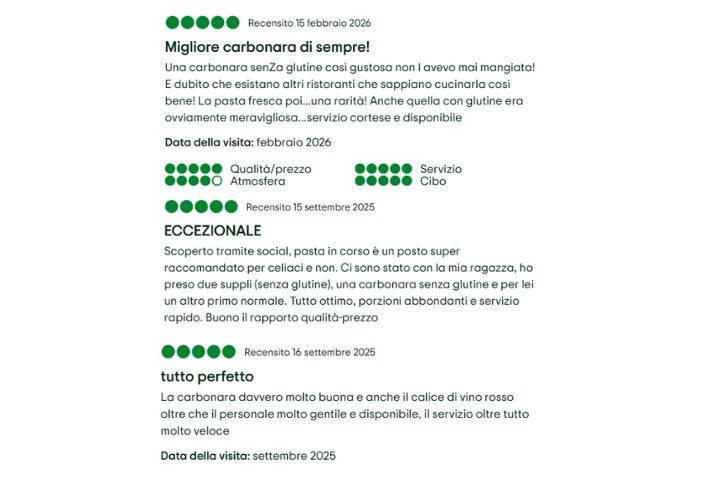
Many customers come to our restaurant specifically because they are looking for a gluten-free carbonara in Rome that does not make them miss the traditional version. Among the most common reviews are those from guests who say they have finally found a gluten-free carbonara with the same creaminess as classic carbonara. Many customers with celiac disease explain that discovering a completely gluten-free restaurant in Rome where they can enjoy traditional Roman dishes has been an important and memorable experience.
Photos of the dishes clearly show the texture of the pasta and the creaminess of the carbonara prepared with gluten-free pasta.
Here you can find some of the reviews of our gluten-free carbonara - but also not - on TripAdvisor.

PASTA IN CORSO
